NASA’s Voyager 1 Records Unprecedented Discovery at the Edge of the Solar System
NASA’s legendary Voyager 1 spacecraft has made a groundbreaking discovery that is shaking the foundations of modern astrophysics. After more than 48 years of travel through space, Voyager 1 has crossed into a mysterious and fiery region at the edge of the solar system.
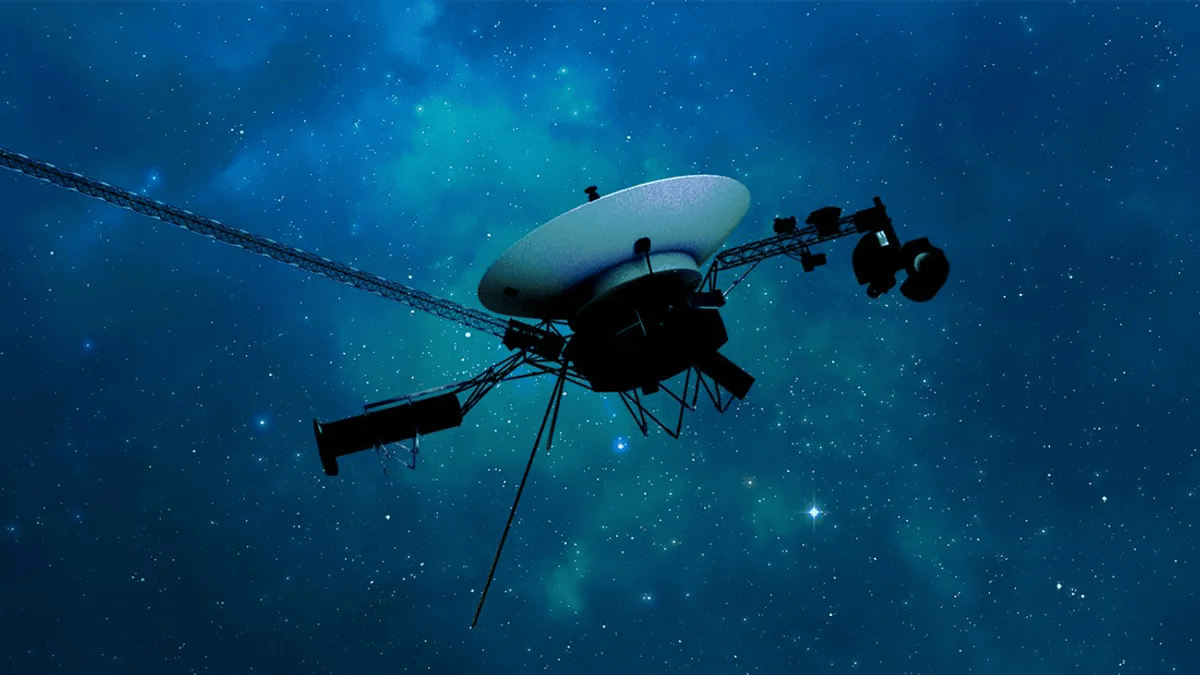
The spacecraft recently detected a “wall of fire” with temperatures reaching up to 30,000°C. This astonishing find, at the boundary of the solar system where solar wind collides with interstellar gas, is reshaping our understanding of space.
Voyager 1’s Incredible Journey
Launched in 1977, Voyager 1 has traveled over 24 billion kilometers from Earth, past Jupiter, Saturn, and their moons. Its mission expanded when it ventured beyond the planetary zone into the outermost reaches of the solar system, nearing the heliopause—the point where the Sun’s influence ends and interstellar space begins. Here, Voyager 1 detected an intense rise in temperature and particle density, which scientists have dubbed the “wall of fire.”
What Is the Heliopause?

The heliopause marks the outermost boundary of our solar system. It is the place where the pressure from the solar wind—particles emitted by the Sun—meets the pressure of the interstellar medium. Beyond this region, particles from other stars flow freely. The heliopause also acts as a shield, protecting the solar system from high-energy cosmic rays. Voyager 1’s detection of the “wall of fire” confirms that even in low-density regions, collisions between stellar winds generate extreme temperatures.
A Fire Wall at 30,000°C
While the “wall of fire” sounds ominous, it’s not a fire in the traditional sense, as space lacks oxygen. Instead, the heat is caused by the kinetic energy of fast-moving particles traveling at near-light speed. These particles collide with one another, generating temperatures in the tens of thousands of degrees. Although Voyager 1 flies through this intense region, it remains unharmed due to the low density of matter and the spacecraft’s path through the region, which avoids substantial resistance.
Magnetic Discoveries
One of the most surprising findings from Voyager 1’s data involves the magnetic fields. Scientists initially expected interstellar magnetic fields to differ from those generated by the Sun. However, the data revealed similarities. This suggests the solar wind can drag magnetic field lines from the heliosphere into the interstellar medium, causing magnetic reconnection. This phenomenon transforms the kinetic energy of particles into heat, contributing to the “fire wall” effect.
Voyager 1: A Spacecraft That Keeps On Giving
At 48 years old, Voyager 1 is operating on minimal power, relying on its aging plutonium batteries. However, NASA engineers have optimized the spacecraft’s power consumption to keep its instruments running, ensuring the continued collection of crucial data. Despite the challenges posed by its extreme distance and fading power, Voyager 1 is expected to continue sending valuable information back to Earth until at least 2030.
What’s Next for Voyager 1?
Beyond the heliopause, Voyager 1 will continue to explore the interstellar medium, providing invaluable insights into cosmic phenomena. The spacecraft’s findings are crucial for refining our models of the heliosphere’s structure, which will help future space missions—especially those venturing beyond Pluto or even into deep space. As it remains the farthest human-made object from Earth, Voyager 1’s journey is far from over, with new discoveries waiting just beyond the horizon.
What do you think about this groundbreaking discovery by Voyager 1? How do you think it will influence future space exploration?
More…