
TSB Update: New Details on Delta Plane Crash Investigation at Pearson Airport
It has been nearly a year since the dramatic crash of a Delta Connection flight gripped Toronto, and investigators are finally sharing what they’ve learned—and what remains a mystery.
On Thursday, February 12, 2026, the Transportation Safety Board of Canada (TSB) released a critical update regarding the fiery crash of the Bombardier CRJ-900 at Pearson International Airport. While the public is eager for a final verdict, the TSB has made it clear: the investigation is far from over.
According to the official TSB update, the probe remains in the “examination and analysis phase.” This is classified as a Class 2 occurrence, meaning it is complex and involves significant safety issues that require exhaustive study. As a result, officials state it is still “too early to draw conclusions” regarding the root cause.
Deep Dive: Metallurgical Testing Complete
While the final report is pending, investigators have completed crucial technical steps. The TSB confirmed that a comprehensive metallurgical examination of the aircraft’s wreckage is finished. This focused heavily on the fracture surfaces of the landing gear and the wing, which separated from the fuselage upon impact.
Investigators have also successfully downloaded and analyzed data from the flight recorders—the “black boxes.” This includes the cockpit voice recorder and flight data, which will be instrumental in understanding the crew’s actions and the aircraft’s performance in those final, terrifying seconds.
The Day the Runway Ignited: A Look Back
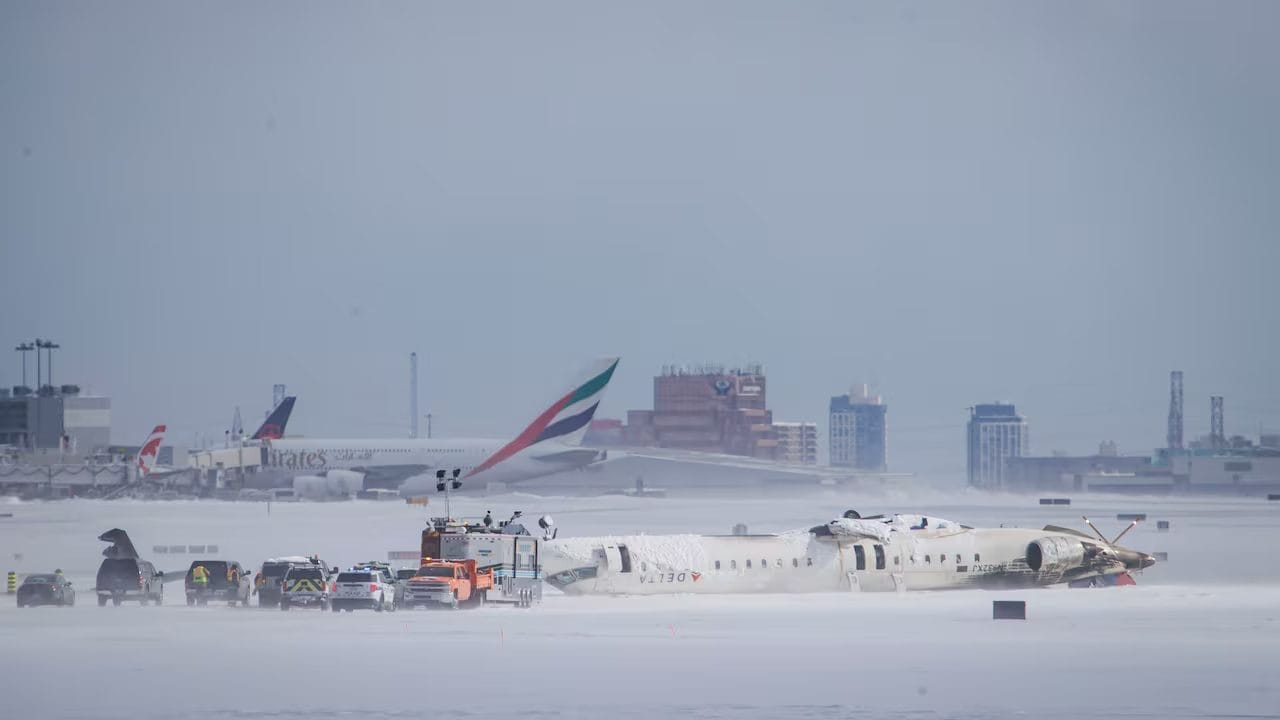
The events of February 17, 2025, are still fresh in the minds of many Torontonians. Endeavor Air Flight 4819, arriving from Minneapolis with 80 people on board, struck Runway 23 with immense force.
As detailed by CBC News, the impact caused the landing gear to collapse and the right wing to detach. This catastrophic structural failure severed fuel lines, sparking a fire that trailed the jet as it skidded across the tarmac before flipping upside down.
Miraculously, every single person survived. However, the evacuation was fraught with challenges. CTV News reports that the impact jammed the cockpit door shut, trapping the pilots. The flight crew was forced to escape through an emergency hatch in the cockpit ceiling, while passengers and cabin crew fled through the forward door and an over-wing exit.
Twenty-one occupants were treated for injuries, ranging from fractures to smoke inhalation, but all have since recovered.
What the Investigation is Focusing On Now
To reconstruct the accident, the TSB has gone beyond physical wreckage. Investigators have conducted flight simulator exercises to replicate the approach and landing profile. Global News notes that experts are currently analyzing these simulations to determine if wind shear or pilot handling played a decisive role.
Weather data has also been scrutinized. The TSB has completed a review of the meteorological conditions at the time of the crash, including specific wind soundings. Preliminary findings suggested the aircraft may have encountered a wind gust that increased its descent rate, prompting a correction that arguably came too late.
Comparison with Global Incidents
This investigation isn’t happening in a vacuum. The TSB is actively comparing the Pearson crash with similar occurrences worldwide involving the CRJ-900 aircraft. By identifying patterns in how this specific jet behaves during hard landings, they hope to uncover systemic safety deficiencies that could affect fleets globally.
Legal and Corporate Aftermath
As the technical team works, the legal battle continues. Multiple passengers have filed lawsuits against Delta Air Lines in U.S. courts, seeking damages for the trauma and injuries sustained.
In the immediate aftermath, Delta offered passengers $30,000 USD in compensation, stating the payment had “no strings attached.” Both Delta and its subsidiary, Endeavor Air, maintain they are fully cooperating with the TSB’s ongoing inquiry.
What Travelers Need to Know
For those flying through Pearson, it is reassuring to see the depth of this investigation. The TSB’s rigorous process—examining everything from metal fatigue to emergency response coordination—ensures that if there is a flaw in the system or the aircraft, it will be found and fixed.
We will continue to track this story and provide the final TSB report findings as soon as they are released to the public.
Related Reads:


